


When a maintenance engineer in Suzhou encountered a breaker truck that would not move smoothly into its service position during a commissioning drill, the team suspected a defective mechanism. The reversal came after checking the cubicle: construction dust had contaminated the guide rails because the specification treated “indoor” as a location rather than a controlled environment. This illustrative scenario carries a practical lesson—the breaker, enclosure, room, and maintenance process form one protection system.
Summary: An indoor VCB interrupts medium-voltage current in a vacuum bottle but relies on indoor switchgear and the electrical room for protection from weather, contamination, and unauthorized contact. IEC 62271-100 addresses AC circuit breakers above 1 kV, while IEC 62271-200 covers metal-enclosed switchgear up to 52 kV; neither makes every indoor installation equivalent. Specify the complete assembly, confirm service conditions and interlocks, and plan safe access before comparing breaker price.
What “indoor” changes in a vacuum circuit breaker specification
An indoor vacuum circuit breaker operates inside a building or enclosure that limits rain, solar loading, debris, and rapid temperature swings. The vacuum interrupter performs the switching duty, but insulation surfaces, secondary plugs, shutters, and racking parts remain sensitive to condensation and contamination. “Indoor” therefore describes the expected service environment; it is not a blanket ingress-protection claim.
IEC 62271-100 provides the circuit-breaker framework for AC equipment above 1 kV, including voltage, normal current, short-circuit duties, and mechanical performance. Match the rating to the system study rather than selecting only by nominal voltage. A 12 kV or 17.5 kV class label does not prove that interrupting current, transient recovery voltage, operating sequence, or control supply suits the application.

The hidden cost appears when the specification stops at the nameplate. A lower initial breaker price can be outweighed by cubicle modifications, incompatible primary contacts, new secondary wiring, longer outages, or unavailable lifting and racking tools. For retrofit work, verify interface dimensions and operating geometry early; this mounting and retrofit configuration guide explains why mechanical fit must be treated as an engineering deliverable.
How metal-clad indoor switchgear provides controlled-environment protection
Metal-clad or metal-enclosed switchgear separates live parts from normal operating areas and can provide distinct breaker, busbar, cable, and low-voltage compartments. In withdrawable designs, shutters cover primary disconnects when the breaker is removed, while interlocks help prevent unsafe sequences. IEC 62271-200 addresses prefabricated AC metal-enclosed switchgear above 1 kV and through 52 kV, including classifications for partitioning, service continuity, and internal arc performance when specified and tested.
Interlocking should make the operating sequence clear. A typical design prevents racking a closed breaker, prevents closing between defined positions, and identifies connected, test, and disconnected states. Logic varies by project, so request the interlock matrix, control schematic, and instructions rather than assuming those three positions behave identically.

Protection extends beyond the cubicle. Ventilation, leakage, cable-trench moisture, dust-generating processes, heating, and housekeeping all affect insulation reliability. Under IEC 60529, the first IP numeral 5 means dust-protected and 6 means dust-tight, but a documented IP code applies only to the tested configuration. Open doors, filters, cable entries, and maintenance can change actual protection.
Maintenance access must support inspection without encouraging shortcuts. Provide room for the manufacturer’s racking method, breaker removal, lifting equipment, door travel, cable testing, and safe work boundaries. NFPA 70E is a workplace electrical-safety standard—not a breaker certification—and its risk-assessment approach reinforces the need to consider equipment condition, task, exposure, and documented work practices before access.
Indoor versus outdoor ratings: compare the system, not one label
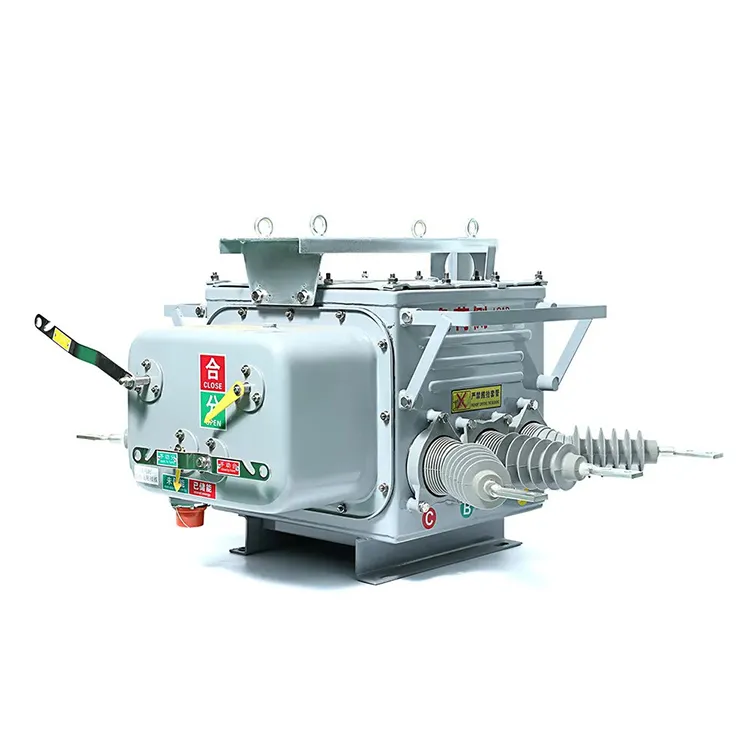
Indoor and outdoor breakers may use similar vacuum interruption principles while differing in insulation, enclosure, environmental qualification, mounting, and accessories. An outdoor unit may need weather-resistant housings, bushings, heaters, corrosion protection, and exposed-site controls. An indoor unit transfers much of that duty to the building and switchgear.
| Decision factor | Indoor VCB in switchgear | Outdoor VCB |
|---|---|---|
| Environmental barrier | Building plus switchgear enclosure | Equipment housing and site installation |
| Insulation coordination | Coordinated with cubicle clearances and internal interfaces | Coordinated with external clearances, pollution, and exposure |
| Interlocking | Often integrated with shutters and connected/test/disconnected positions | Typically coordinated with local mechanism, isolation, and site scheme |
| Maintenance | Access depends on aisle, door, truck, and compartment design | Access depends on structure, weather, elevation, and site controls |
| Unit-cost tendency | Breaker cost excludes room and switchgear protection | Equipment carries more environmental hardware |
| Total cost of ownership | Driven by compatibility, cleaning, access, spares, and outage time | Driven by weather exposure, structures, corrosion control, and field access |
For a detailed counterpart, compare the enclosure and service assumptions in this outdoor vacuum circuit breaker guide. Do not substitute an indoor unit outdoors merely because voltage and current ratings match; use only equipment documented for the destination environment and complete installation.
| Application condition | Key question | Specification response |
|---|---|---|
| Clean electrical room | Are temperature, humidity, and access controlled? | Confirm normal service conditions, room ventilation, and assembly rating. |
| Dusty industrial plant | Is dust conductive, abrasive, combustible, or corrosive? | Assess room segregation, filtration, enclosure IP code, cleaning interval, and hazardous-area obligations. |
| High humidity or condensation risk | Can surfaces fall below dew point? | Evaluate heaters, ventilation, sealing, drainage, and humidity monitoring. |
| Retrofit cubicle | Do contacts, shutters, interlocks, and control plugs align? | Require dimensional drawings, interface schedule, and functional checks. |
| Frequent switching | What operating duty and endurance class are required? | State the duty cycle and request documented mechanical and electrical endurance data. |

An illustrative TCO check includes purchase, engineering, cubicle adaptation, commissioning, maintenance, spares, and expected outage cost. If an interface mismatch adds 8 hours to a shutdown, multiply those hours by the facility’s approved downtime basis and add labor and testing. Documentation quality and retrofit fit can outweigh a small unit-price difference.
Which standards and procurement checks matter before ordering an indoor VCB?
Standards have different scopes. IEC 62271-100 addresses breaker ratings and tests; IEC 62271-200 covers assembled metal-enclosed switchgear; IEC 60529 classifies ingress protection. For North American projects, IEEE C37.04 establishes rating structure and IEEE C37.09 covers test procedures. NFPA 70E addresses safe work practices. Citing one does not establish compliance with the others.
Unsupported statements such as “arc resistant,” a specific IP code, or compliance with a test duty can create bid disputes, failed approvals, and expensive retesting. Internal arc classification under IEC 62271-200 applies to a tested switchgear assembly and stated accessibility arrangement; it should not be inferred from the breaker alone. Applicable editions, deviations, and destination-market rules should be listed in the purchase specification and supported by the requested reports.
What should buyers confirm before issuing a purchase order?
- Define system duty. Record rated voltage, frequency, normal current, short-circuit current, operating sequence, insulation level, and control supply from the system study. Use the vacuum circuit breakers indoor test framework to identify the evidence needed for the intended duty.
- Describe the environment. State temperature, altitude, humidity, condensation, pollution, dust properties, corrosion exposure, and room controls. Do not replace these inputs with the word “indoor.”
- Freeze interfaces. Approve general arrangement drawings, primary contact geometry, secondary plug pinout, interlock logic, racking tools, lifting points, and cable-test access.
- Plan verification and upkeep. Agree on routine-test documentation, site checks, lubrication guidance, contact-wear assessment, cleaning criteria, spares, and training before shipment.
Fuerte can support procurement discussions by reviewing the requested ratings, application environment, installation interface, and documentation list against an available breaker configuration. Final suitability still depends on the complete switchgear design, coordination study, destination requirements, and purchaser approval.
Frequently asked questions
What is an indoor vacuum circuit breaker?
It is an AC circuit breaker that interrupts current in sealed vacuum interrupters and is intended for installation inside a protected building or switchgear enclosure. Its indoor rating assumes defined service conditions; the complete assembly must provide the required insulation, barriers, ingress protection, and access control.
What are the benefits of an indoor VCB?
Indoor VCBs can provide compact medium-voltage switching, repeatable mechanical operation, and integration with withdrawable metal-clad switchgear. Their practical value depends on correct duty selection, compatible cubicle interfaces, controlled contamination, and maintainable access—not on interruption technology alone.
How does indoor switchgear protect a vacuum breaker?
The switchgear enclosure provides barriers, compartments, shutters, interlocks, primary insulation interfaces, and a controlled path for operation and maintenance. Documented partitioning, service-continuity, IP, or internal-arc classifications apply only when the assembly meets the relevant design and test conditions.
Can an indoor VCB be used in a dusty plant?
Yes, if an engineering assessment shows that the room and enclosure adequately control the specific dust and the maintenance plan preserves insulation and mechanisms. Conductive, abrasive, combustible, or corrosive dust may require segregation, filtration, higher enclosure protection, special cleaning, or additional hazardous-location measures.
What maintenance access is needed for indoor VCBs?
Allow access for safe racking, visual inspection, cleaning, lubrication where specified, mechanism checks, breaker removal, lifting, cable testing, and functional interlock tests. Clearances and work controls should follow the assembly manufacturer’s instructions, the facility safety program, and applicable local rules.
How do indoor and outdoor VCB ratings compare?
Both must match system voltage, normal current, insulation, and interruption duties, but outdoor equipment also needs documented suitability for weather, pollution, temperature variation, and exposed installation. Matching nameplate voltage and current does not make indoor and outdoor units interchangeable.
References
- IEC 62271-100, High-voltage switchgear and controlgear—AC circuit-breakers.
- IEC 62271-200, AC metal-enclosed switchgear and controlgear above 1 kV and up to and including 52 kV.
- IEC 60529, Degrees of protection provided by enclosures (IP Code).
- IEEE C37.09, Test procedure for AC high-voltage circuit breakers.
- NFPA 70E, Standard for Electrical Safety in the Workplace.
Indoor reliability begins with a simple principle: protect the entire operating environment, not only the vacuum bottle. To discuss a documented configuration for your project, review Fuerte’s 11 kV 630 A vacuum circuit breaker reference and contact the team with your single-line diagram, duty data, environmental conditions, and cubicle interface drawings.