
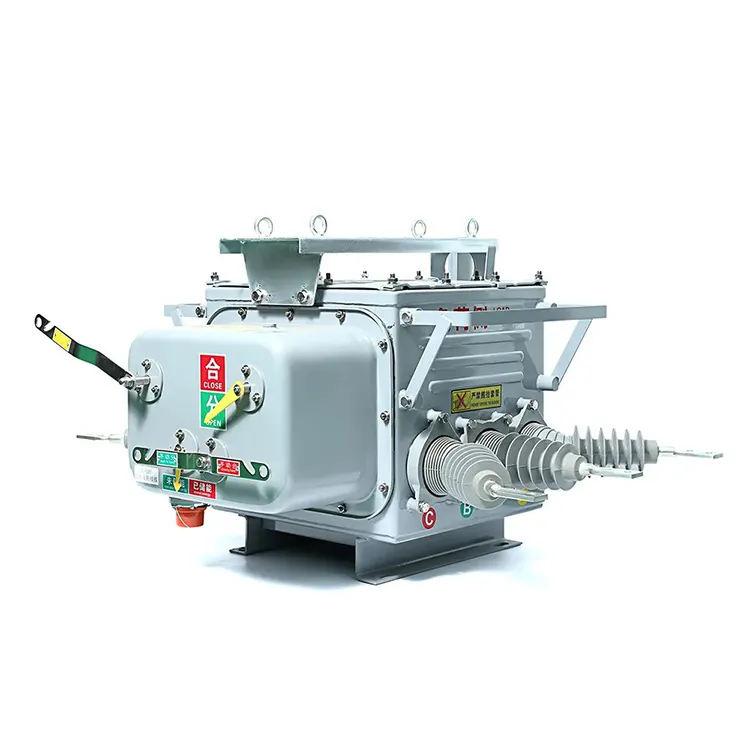
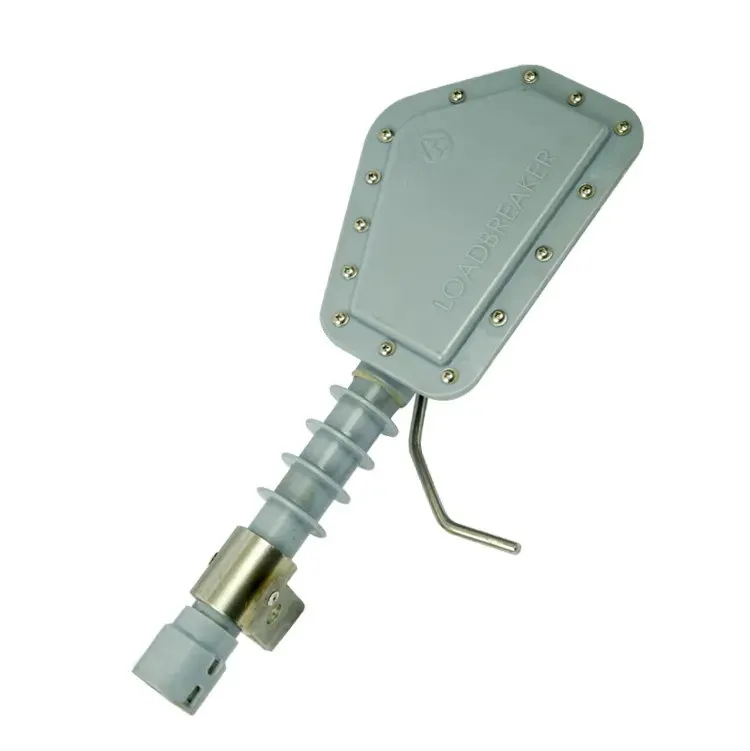


A monitoring retrofit is worth considering when a maintenance team has a question it cannot easily answer from existing records. Is the mechanism taking longer to operate? Is a connection running hotter under a similar load? Has the control supply become unreliable? Those questions lead to useful measurements. Adding a gateway first and deciding what to do with its data later can leave the owner with alarms that nobody knows how to investigate. The choice should begin with the breaker, its service history and the maintenance work that better information could help plan.
Vacuum circuit breaker smart monitoring is most useful on equipment where an early indication of change can prompt a worthwhile inspection or repair. Critical feeders, frequently operated breakers and difficult-to-access installations may benefit. A lightly used breaker due for replacement soon may justify a smaller investment. In either case, choose signals that the installed design can support, establish normal behaviour and decide who will act on a change. IEC 62271-100 still applies to the breaker’s performance: monitoring supplements the maintenance programme and does not replace protection or the required offline tests.
Which measurements can help explain a developing breaker problem?
Operation counts and event logs show how the breaker has been used. Command and auxiliary-contact times can reveal a change in the operating sequence. A supported coil-current measurement can help investigate the control and mechanism response. Temperature measurements can draw attention to a thermal change at the point being observed.
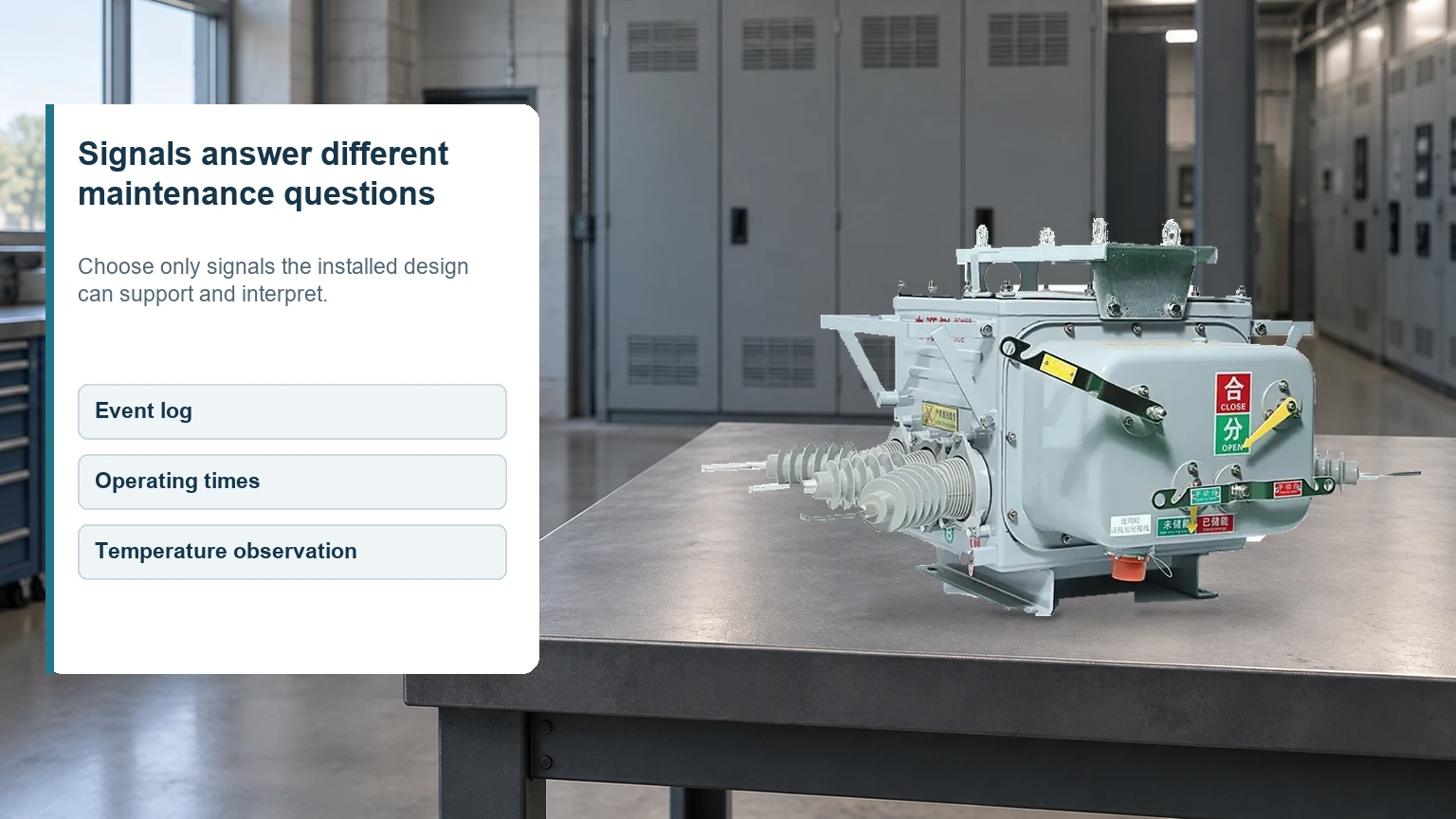
These measurements answer different questions. A hot connection may need investigation, but its temperature is also affected by load and ambient conditions. An auxiliary contact reports its own change of state, which is not automatically the same as a direct measurement of main-contact travel. Knowing that distinction helps the maintenance team choose the next test.
| Signal | What it can help investigate | What to consider when reading it |
|---|---|---|
| Operation count and event log | Accumulated use and the timing of events | Fault severity is not shown by the count alone |
| Command and auxiliary-contact times | A change in the operating sequence | How the recorded signal relates to main-contact movement |
| Coil-current signature | Changes in the supported trip or close circuit | The normal signature and the manufacturer’s interpretation method |
| Temperature at a defined location | A developing thermal concern | Load, ambient temperature and sensor position |
| Control-supply and communication status | Loss of control power or loss of observation | Whether the breaker remains observable and which functions are affected |
Vacuum integrity is a separate concern. A gateway cannot establish it simply by collecting operation or temperature data. Similarly, online temperature observation does not replace contact-resistance measurement. The retrofit should make the existing maintenance work better informed, rather than imply that every condition is being measured continuously.
Can the monitoring equipment be fitted to the existing breaker?
For vacuum circuit breaker retrofit mounting, available space is only the first question. Added hardware must leave the mechanism, shutters, racking movement and maintenance access unobstructed. It must also preserve the required insulation clearances. Review the installed assembly rather than assuming that a kit that fits a standalone breaker will fit the panel.
The guide to retrofit mounting and controls covers these mechanical and electrical interfaces. For the monitoring package, establish where each signal will come from, how the equipment will be powered and how its wiring will be routed.
Keep the protection trip path clear in the design. Reading data and issuing a remote command are different functions. If remote operation is included, its permissions, interlocks and commissioning need to be specified alongside the monitoring work. A display labelled “connected” does not establish that the complete trip or close function has been tested.
What does a supplier mean by a digital-ready breaker?
The phrase needs a product-specific answer. It might describe available sensors, a controller option or a communications interface. Ask which hardware and functions are included in the quoted version and which require additional equipment.
ABB’s primary breaker information, for example, describes optional sensors and a concentrator for VD4 evo Digital, while its product table qualifies monitoring availability by rating. This shows why a family name is not enough to specify a monitoring package. The exact version and its supported signals matter.
When comparing vacuum circuit breaker digital integration features, ask for a signal list, sensor locations, supply requirements and interface documents. Where the project specifies IEC 61850, also establish the required functions, configuration files and time synchronisation. IEC 61850-8-1:2011 describes a communication-service mapping; the project must identify the applicable edition and how the connected devices will be tested together.
What should happen when a monitoring alarm appears?
An alarm should lead to an investigation that the maintenance team can actually perform. For a temperature change, that may begin with comparing load and ambient conditions, followed by inspection during an approved outage. For a change in operating behaviour, it may involve checking the control supply and carrying out the prescribed mechanism tests.
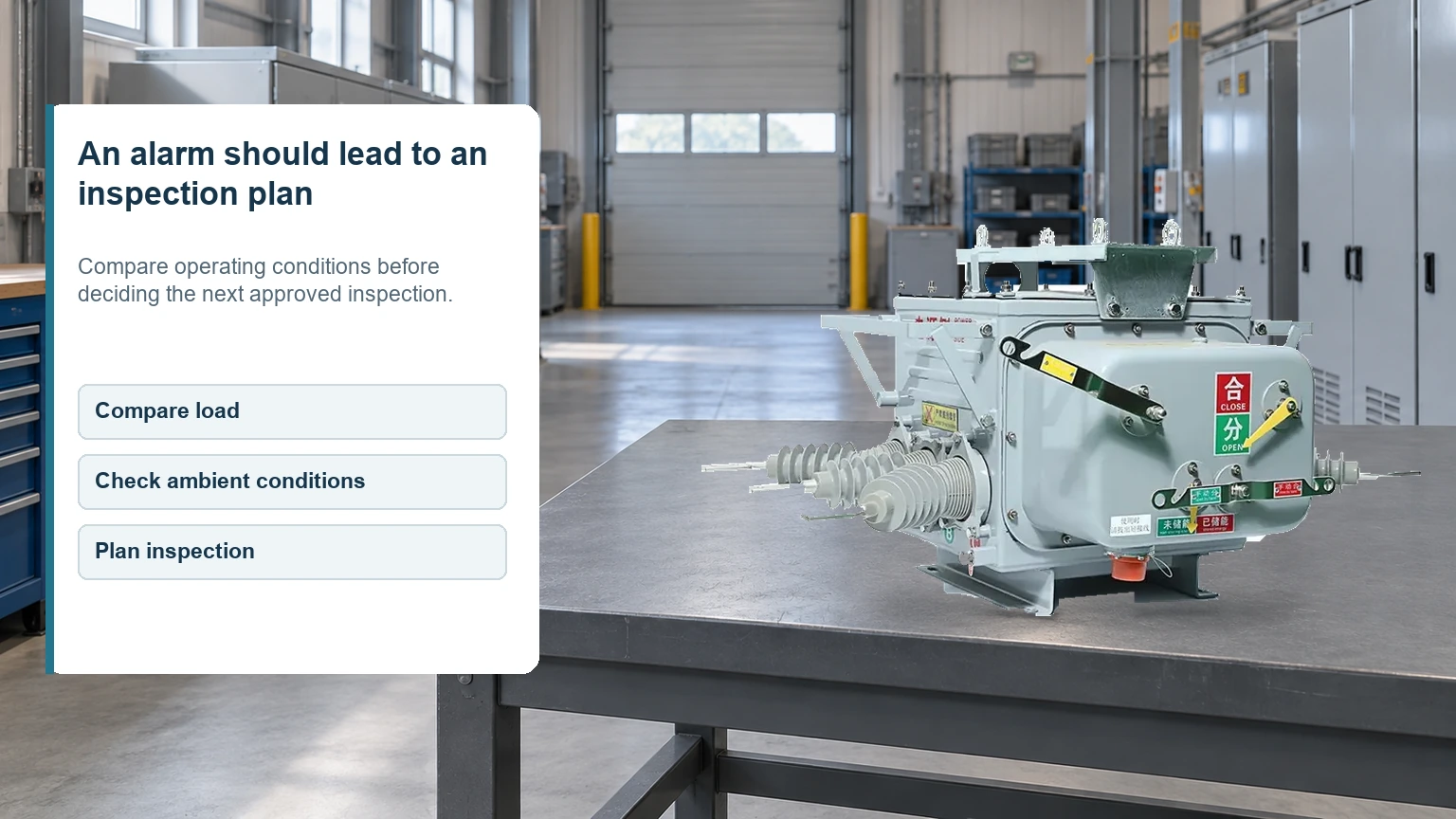
Agree who receives the alarm, what information accompanies it and when it must be escalated. A new monitoring signal should not automatically trip a circuit unless that function has been separately engineered into the protection scheme.
| Part of the monitoring plan | Practical question to resolve |
|---|---|
| Baseline | What did the signal look like when the breaker was in acceptable condition? |
| Alarm limit or trend rule | Which change calls for investigation, and under which operating conditions? |
| Responsibility | Who checks the observation and raises the work order? |
| Lost data | How will the team know that a sensor or connection has stopped reporting? |
| Follow-up | What did inspection find, and did the alarm lead to useful work? |
Preserve timestamps, units and data-quality flags. A sensor replacement or configuration change belongs in the asset record because it can change how readings compare with earlier data. Missing readings must be identifiable as missing; they should not look like a return to normal.
How can the owner decide whether the retrofit was worthwhile?
Review the decisions the information has helped make. Has it prompted a useful inspection, clarified an operating problem or improved outage planning? If the result is a growing list of unexplained alarms, revisit the signals and response rules before adding more sensors.
For an enquiry involving Fuerte’s ZW20-12/630-20 controller options, the published listing mentions remote/local functions, protection, reclosing and event information, subject to configuration. Request the actual controller and interface documents for the intended installation. That will establish which observations are available and what additional monitoring equipment, if any, is needed.
Frequently asked questions
What does a circuit breaker monitor?
It depends on the installed sensors and controller. Possible signals include operations, events, control voltage and selected condition measurements. Ask for the channel list rather than assuming that all aspects of breaker condition are covered.
Can a circuit breaker be upgraded?
Controls, monitoring functions or the complete breaker can sometimes be renewed. The scope depends on the existing ratings, panel interfaces and available support.
Can circuit-breaker monitoring be retrofitted to an existing breaker?
It may be possible if suitable signals, mounting space and auxiliary power are available. The proposed installation must also preserve insulation clearances, movement and maintenance access.
What is the CRM test in a vacuum circuit breaker?
CRM commonly means contact-resistance measurement. It is an offline electrical test, not an online temperature reading.
What must be verified when installing a new circuit breaker?
Check electrical duty, mechanical interfaces, insulation, earthing, controls and protection. For a monitoring package, add signal identification, baseline records, alarm tests and loss-of-data checks.
What are common condition-monitoring techniques for circuit breakers?
They include event and operation tracking, supported coil-current analysis, operating-time trends and temperature observation. Choose the combination that addresses the condition concerns on the installed equipment.
References
- IEC 62271-100:2021+AMD1:2024 — Alternating-current circuit-breakers.
- IEC 61850-8-1:2011 — Specific communication service mapping; project requirements determine the applicable edition.
- ABB — Primary Vacuum Circuit Breakers, optional digital equipment and availability; reviewed 16 October 2026.
Summary
A useful monitoring retrofit begins with a maintenance question and ends with an action someone is responsible for taking. Choose the signals that can help answer that question, check how they can be obtained from the existing equipment, and record a baseline before relying on trends. Alarms need an investigation plan, while data loss needs to be visible. Keep protection functions and prescribed offline tests in the maintenance programme. The value lies in better decisions about the breaker, rather than the number of channels on a dashboard. Fuerte can review the required controls and interfaces through a retrofit enquiry.