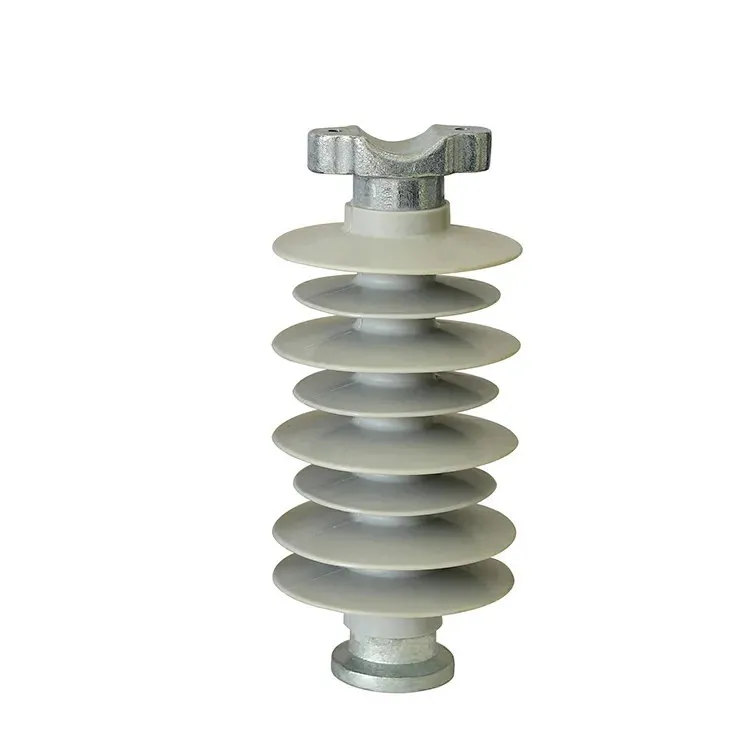


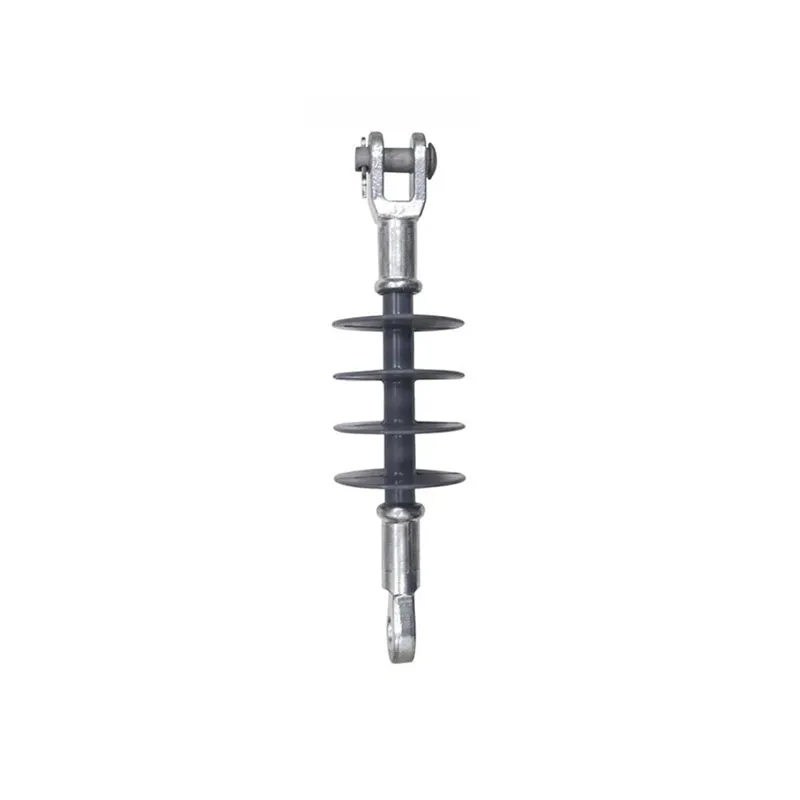
A long rod polymer insulator is a one-piece composite suspension or tension insulator used primarily to carry tensile load while electrically separating an overhead conductor from its support. A common construction combines a fibre-reinforced resin core, polymeric housing and sheds, and metal end fittings permanently attached to the core.
Procurement rule: “long rod,” nominal voltage and overall length are not a complete specification. The buyer must define the mechanical load, electrical withstand, pollution design, end fittings, arcing distance, housing system, electric-field-control arrangement and the test evidence that covers the offered design.
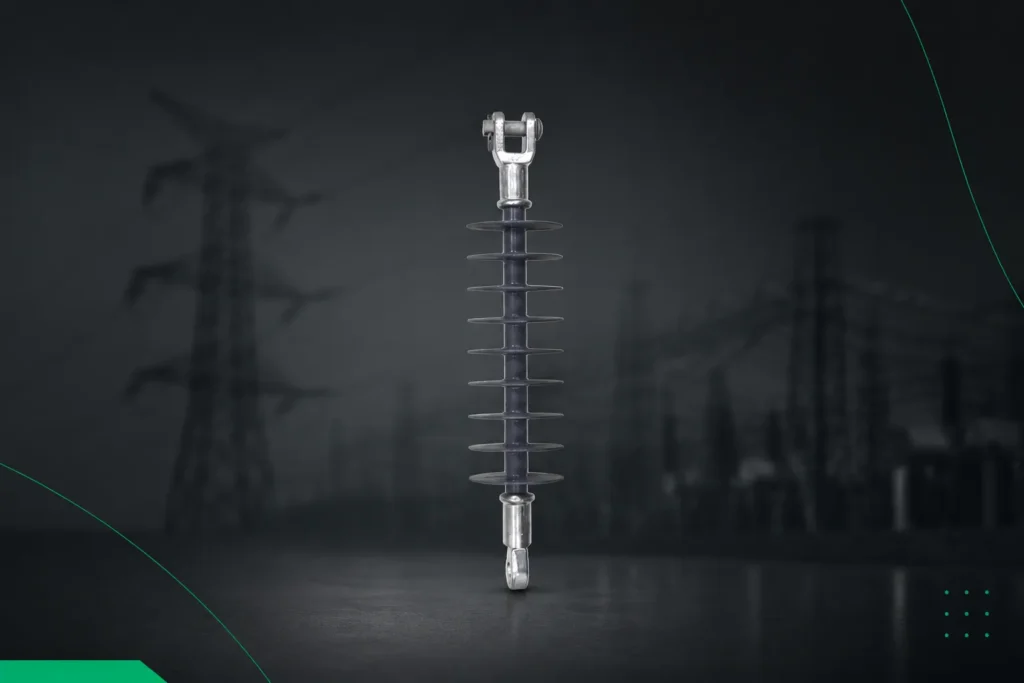
What does the long-rod construction do?
The metal fittings transfer line load into the solid composite core. The core carries the main tensile stress. The housing and sheds protect the core and create the external insulating surface. This differs from a string made from several cap-and-pin ceramic or glass units: a long-rod assembly is normally one continuous insulating body between fittings.
The complete load path matters. A unit intended for axial suspension or tension can encounter secondary bending, compression or torsion during handling, installation or certain applications. IEC 61109:2025 notes that composite suspension/tension insulators may occasionally see compression or bending, such as in interphase spacers, and provides guidance on such loads. That does not make every long-rod unit suitable for a post-insulator duty.
For the broader construction background, see our explanation of composite polymer insulators. It covers the core, housing, interfaces and material limits that are also relevant here.
IEC 61109:2025 changes the evidence buyers should request
The third edition of IEC 61109 was published in 2025 and replaces the 2008 edition. It applies to composite suspension and tension insulators on overhead lines above 1,000 V AC and above 1,500 V DC within its stated scope. The revision extends coverage to AC and DC systems, changes test classification and interface relevance, revises electrical and mechanical procedures, and adds material on AC electric-field control, typical assemblies, core-to-housing adhesion and applicability of design and type tests for DC.
The related general standard, IEC 62217:2025, revises hydrophobicity-transfer, water-diffusion and stress-corrosion evaluation and highlights interfaces between fittings, housing and core. A supplier’s statement that a unit is “IEC type” is not enough. Ask which edition, clauses, design family and exact model the evidence covers.
Translate project loads into an insulator specification
| Input | Why it matters | Evidence to request |
|---|---|---|
| Specified mechanical load (SML) | Defines the declared tensile load basis for the composite suspension/tension unit | Model marking, drawing and applicable mechanical type/sample/routine test records |
| Everyday and exceptional loads | Wind, conductor tension, line angle, ice and broken-wire cases can differ from the catalog headline | Utility load cases and structure/conductor calculations |
| End-fitting type | Controls articulation, hardware compatibility and load transfer | Coupling designation, dimensions, locking details and approved assembly drawing |
| Secondary bending or compression | Can be significant in spacers, handling or misaligned hardware | Application review and manufacturer confirmation within the standard’s guidance |
| Installation handling | Improper lifting can damage sheds, seals or fittings | Handling, lifting, storage and inspection instructions |
Do not infer working load or safety factor from SML alone. The utility or design engineer should define allowable service loads and factors under the governing project rules. The quotation should state the offered SML and any assumptions separately.
Electrical selection requires more than nominal voltage
Record nominal voltage, highest voltage for equipment, AC or DC, frequency, earthing arrangement, lightning-impulse withstand, wet power-frequency withstand and the project’s required clearances. The insulator’s arcing distance, total length and creepage distance are related but are not interchangeable numbers.
Electric-field concentration near energized fittings can affect corona and housing stress. IEC 61109:2025 adds an annex on AC electric-field control. Grading rings or other field-control hardware should be based on the manufacturer’s configuration and project study; copying a ring from another voltage class or unit geometry is not an engineering method.
Pollution design now has a 2025 selection route
IEC TS 60815-1:2025 begins with site pollution severity and a reference unified specific creepage distance, then applies corrections to arrive at the candidate insulator design. The new edition revises altitude, diameter, shed-profile and parallel-insulator corrections and distinguishes hydrophobicity-transfer materials.
IEC TS 60815-3:2025 applies the approach to outdoor polymer insulators for AC systems. It does not cover ice and snow effects. Therefore, a statement such as “silicone rubber is suitable for all pollution” is too broad. Buyers need site data, housing-material evidence, profile information and the documented correction method.
End fittings and interfaces deserve a separate review
The fitting is not only a connector. It transfers tensile force into the core and helps protect the housing-to-core interface from moisture. Review fitting material and corrosion protection, crimp or attachment method, sealing arrangement, dimensional tolerances, locking features and hardware compatibility. The offered fitting must match both the structure hardware and the installation orientation.
Inspect for damaged seals, exposed core, housing separation, cracked or cut sheds, corrosion, deformation and evidence of mishandling before installation. During service, the maintenance plan should define how visual findings, discharge activity and suspected impact are escalated. A universal “maintenance-free” statement hides these inspection decisions.
How to compare two supplier quotations
- Normalize identity: model, drawing revision, materials, fitting code and included grading hardware.
- Normalize ratings: SML, electrical withstand levels, dimensions, arcing distance and declared creepage distance.
- Normalize site assumptions: altitude, pollution severity, temperature range, UV, wind, ice/snow and corrosion environment.
- Normalize evidence: standard edition, design family, type tests, sample and routine tests, traceability and exceptions.
- Normalize delivery scope: line hardware, locking devices, packaging, installation tools, spares and documentation.
Use the polymer suspension insulator selection guide when the project is a suspension application. For a dead-end or line-angle duty, review the separate polymer dead-end insulator requirements because the mechanical and hardware assumptions can differ.
Frequently asked questions
Is a long rod polymer insulator the same as a disc insulator?
Catalog language varies. A composite “disc” product may actually be a one-piece long-rod suspension or strain unit rather than a ceramic-style disc. Confirm the drawing, load path, fittings and applicable standard.
Can the same long rod unit be used for suspension and tension?
Only when the manufacturer and project design confirm that the exact unit, fittings and assembly are suitable for both arrangements and their loads. Do not infer compatibility from appearance.
What is the service life of a long rod polymer insulator?
There is no universal evidence-based number. Design family, materials, interfaces, electric field, environment, load history, handling and inspection condition all matter.
Can a unit be selected from SML and voltage alone?
No. Those are necessary inputs, but electrical withstand, pollution design, altitude, fittings, clearances, field control and test coverage also need verification.
What documentation should arrive with the shipment?
Require the approved drawing, packing list, model and lot identification, applicable routine/sample test records, material or coating documentation specified by the contract, installation instructions and any agreed certificates. Verify that the documents identify the supplied configuration.
Conclusion
A long rod polymer insulator is best specified from its actual suspension or tension duty. Buyers should align SML and line loads with the required insulation levels, pollution design, fittings, interfaces and electric-field-control arrangement, then confirm that the submitted tests cover the offered design family. This approach makes supplier quotations comparable and reduces the risk of approving a unit that matches the voltage class but not the mechanical or environmental application. For a related technical topic, see 11 KV Polymer Disc Insulator.
References
- International Electrotechnical Commission, IEC 61109:2025.
- International Electrotechnical Commission, IEC 62217:2025.
- International Electrotechnical Commission, IEC TS 60815-1:2025 and IEC TS 60815-3:2025.