
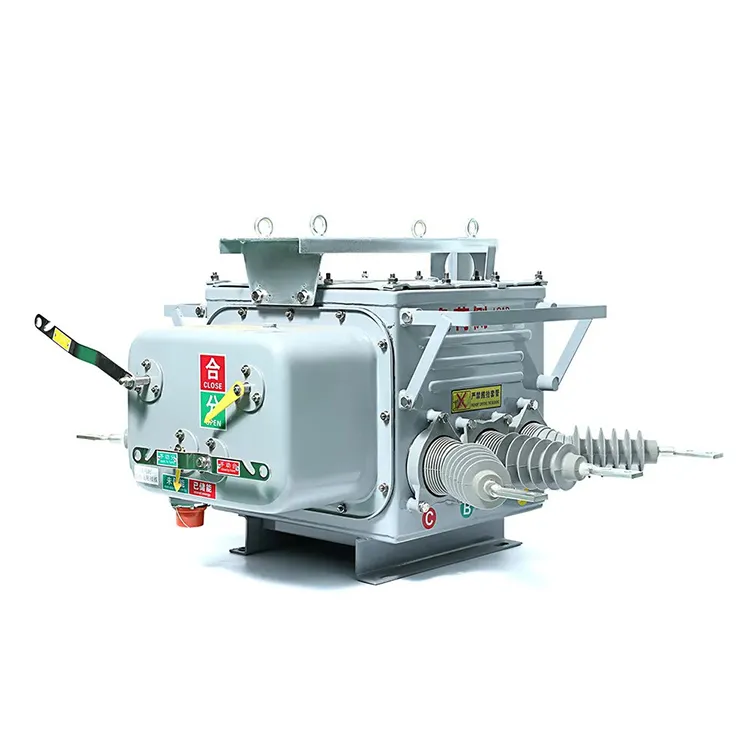
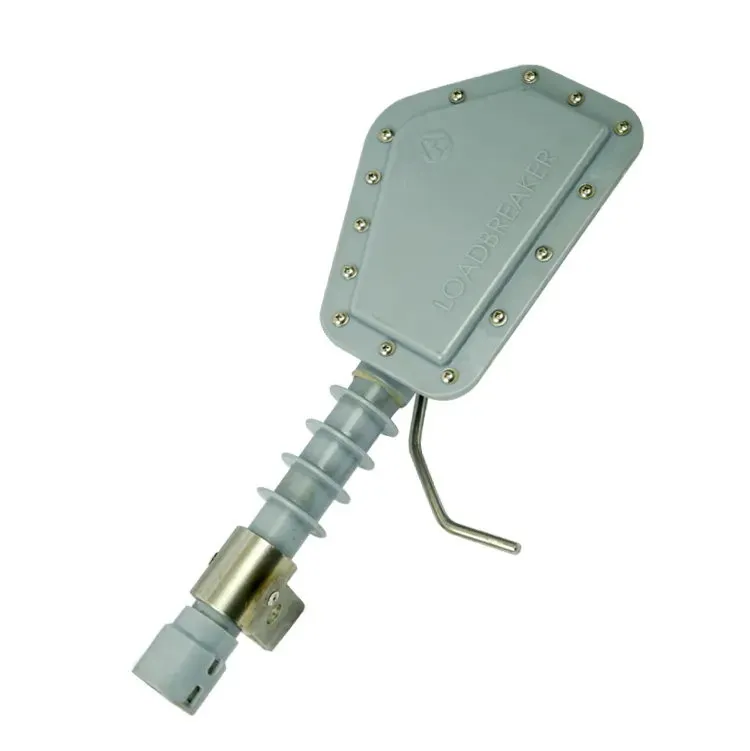


Summary: A vacuum circuit breaker (VCB) carries normal load current, opens a circuit on command, interrupts fault current in a sealed vacuum interrupter, and creates a controlled boundary for isolation and maintenance. In medium-voltage switchgear, the breaker must be selected against rated voltage, continuous current, short-circuit breaking current, making current, operating sequence and the enclosure’s internal-arc requirements. IEC 62271-100 covers the breaker itself; IEC 62271-200 covers AC metal-enclosed switchgear. Confirm the complete duty and protection coordination with a qualified engineer before ordering or energising equipment.
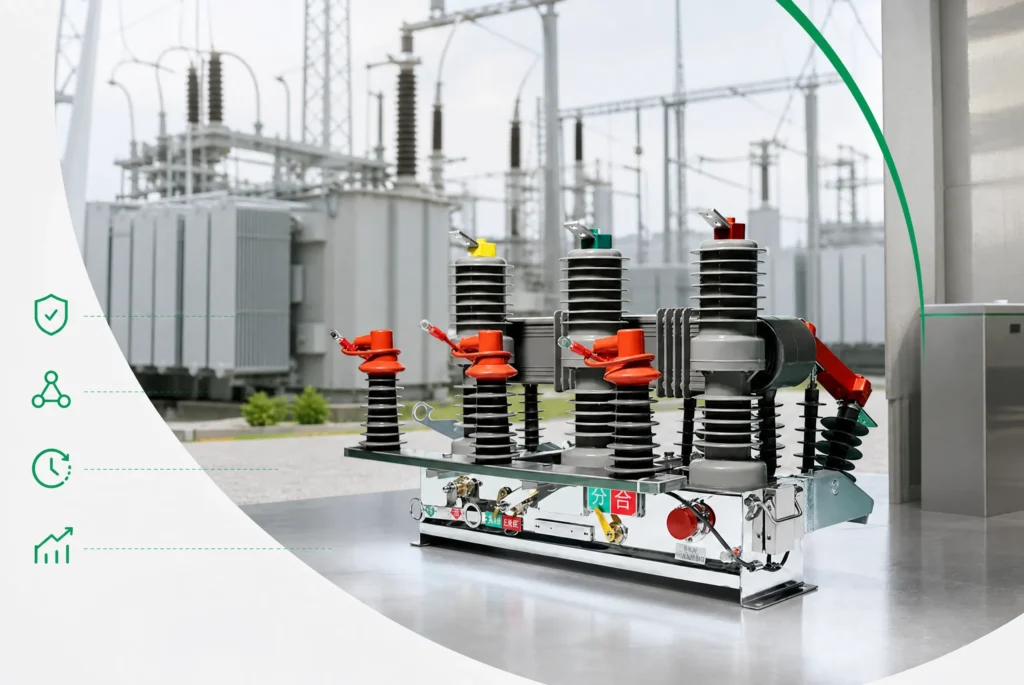
For operating sequence and arc behaviour, see how a vacuum circuit breaker works. For terminology and construction, see what a vacuum circuit breaker is.
What a VCB actually does in a power system
A VCB is a switching and protection device, usually applied on medium-voltage feeders, transformers, motors, capacitor banks and incoming or bus-section circuits. Its primary functions are straightforward:
- Make and carry current: closed contacts provide a low-resistance path for the specified continuous current under the manufacturer’s temperature-rise conditions.
- Switch a healthy circuit: an operator or control system can open or close the circuit for planned transfer, energisation or de-energisation.
- Interrupt a fault: a trip signal separates the contacts and the vacuum interrupter extinguishes the arc at a current zero, limiting the time that fault energy is applied to the network.
- Support a safe work boundary: the breaker participates in the isolation, interlocking, earthing and access procedure; it is not, by itself, proof that a circuit is safe to touch.
Protection relays, current transformers, trip coils, stored-energy mechanisms and the switchgear enclosure all contribute to those functions. The breaker responds to a command; the relay decides whether the measured electrical condition warrants that command.
How vacuum interruption protects equipment
Inside the interrupter, the contacts separate in a high-vacuum environment. A metal-vapour arc forms briefly from the contact material, then loses its sustaining path as the current approaches zero and the gap recovers dielectric strength. This principle avoids the oil handling associated with oil breakers and the gas-management procedures associated with SF6 equipment, but it does not remove the need for correct ratings or testing.
The practical function is selective interruption: the VCB should clear the current that its protection scheme assigns to it while allowing upstream and downstream devices to coordinate. A nameplate breaking-current value is not a universal promise. The project team must compare prospective short-circuit current, X/R ratio, transient recovery voltage, asymmetry and the specified operating sequence with the manufacturer’s type-test evidence.
| Function | What happens | Evidence to check |
|---|---|---|
| Normal switching | Contacts close or open on an operator, motor or remote command. | Rated voltage, continuous current, control voltage and endurance class. |
| Fault interruption | Relay trip signal opens contacts; the vacuum gap interrupts current at current zero. | Rated short-circuit breaking current, making current and test-duty sequence under IEC 62271-100. |
| Isolation coordination | Breaker, disconnector and earthing switch establish the intended circuit boundary. | Interlocking diagram, visible/position indication and switchgear access procedure. |
| Reclosing or restoration | After inspection or a cleared transient fault, the mechanism can follow an approved close-open sequence. | Protection settings, reclosing logic and manufacturer operating-cycle limits. |
Isolation, maintenance and the limits of “safe”
A breaker can interrupt load or fault current, but maintenance safety normally requires more than opening it. Depending on the switchgear design, the process may include opening the breaker, racking it to a test or disconnected position, proving absence of voltage, closing an earthing switch, applying lockout/tagout and controlling access. A disconnector is used for an isolation function where the design provides the required isolation distance; a circuit breaker is not automatically a substitute for that device.
Maintenance teams should follow the equipment manual and the site’s electrical-safety rules. Typical checks include mechanical operation, contact wear indicators, control wiring, interlocks, insulation condition and vacuum integrity using the specified test method. Intervals are application- and design-dependent; a generic “inspection every three to five years” statement is not a commissioning requirement.
The same boundary matters for automatic reclosing. Reclosing can restore service after a transient feeder fault, but it must be enabled only when the protection study, network topology and safety procedure permit it. A permanently energised cable fault, personnel exposure or an unverified work zone is not an acceptable reclosing scenario.
Where the function is useful—and where it is not enough
VCBs are common in indoor and outdoor medium-voltage distribution assemblies, industrial substations, utility feeders, motor control line-ups and renewable-energy collection systems. The application is determined by the network’s voltage and duty, not by the label “vacuum” alone. Some designs extend to higher voltages, while low-voltage systems more often use air circuit breakers or moulded-case devices; verify the actual product rating rather than relying on a rule of thumb.
Vacuum interruption can simplify routine service because there is no breaker oil to inspect and no SF6 gas compartment to manage. That does not prove that every VCB is lower-cost, maintenance-free or environmentally preferable in every installation. Manufacturing, enclosure design, auxiliary equipment, end-of-life handling and the local service network affect total cost and environmental performance.
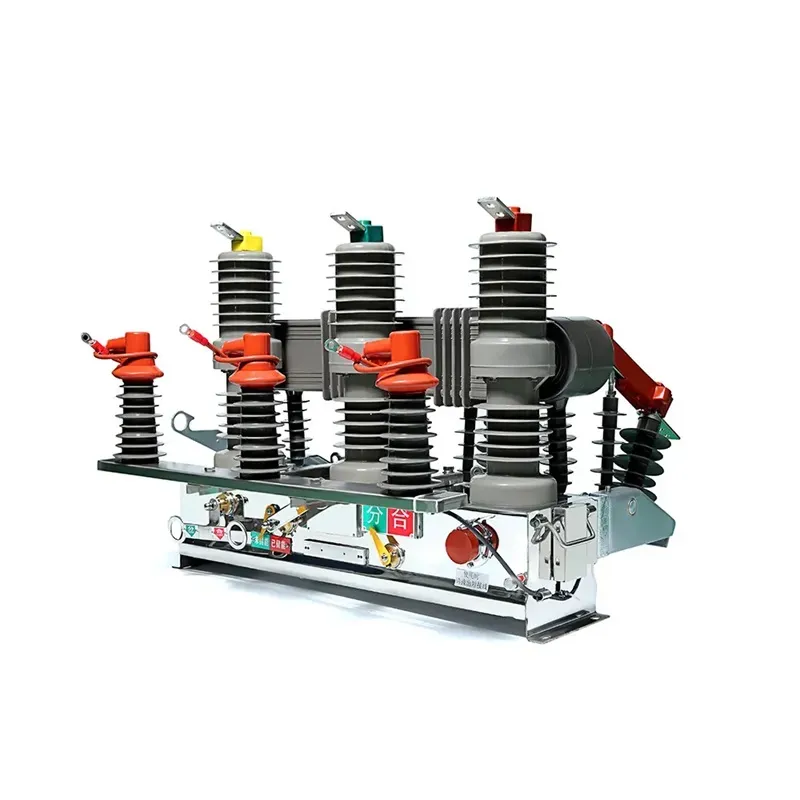
VCB and other interruption technologies: a project-level comparison
The useful question is not which technology is universally “best”, but which interrupter and enclosure meet the duty, access and compliance requirements at the project location.
| Consideration | Vacuum circuit breaker | Air circuit breaker | SF6 circuit breaker | Oil circuit breaker |
|---|---|---|---|---|
| Typical application context | Medium-voltage distribution and industrial switchgear | Commonly low-voltage and some specialised higher-current duties | High-voltage and selected medium-/high-voltage installations | Legacy and specialised installations |
| Interruption medium | Sealed vacuum interrupter | Air | Sulfur hexafluoride gas | Insulating oil |
| Procurement focus | Breaking duty, switching performance, mechanism and vacuum integrity | Arc-chute design, current rating and enclosure coordination | Gas pressure, leakage management and applicable environmental rules | Oil condition, fire protection, containment and maintenance |
| What cannot be assumed | Not automatically maintenance-free or suitable for every voltage | Not automatically interchangeable with a VCB | Not automatically disallowed; destination rules and project policy apply | Not automatically unsuitable; risk and service history must be assessed |
Standards that define the equipment boundary
- IEC 62271-1 sets common specifications for high-voltage switchgear and controlgear, including service conditions, ratings and general test principles.
- IEC 62271-100 addresses AC circuit-breakers and their type and routine testing requirements.
- IEC 62271-200 covers AC metal-enclosed switchgear and controlgear for rated voltages above 1 kV and up to 52 kV, including enclosure and internal-arc classifications.
These are standards documents, not a blanket certificate for a brand or a complete installation. The edition adopted by the purchaser, local grid code, utility specification and destination-market rules control the contractual requirement. Ask for the applicable type-test reports, routine-test records, drawings and declarations; do not market an assembly as compliant based only on a component name.
Selection checklist for buyers and engineers
- Record system voltage, frequency, earthing arrangement, continuous load current and prospective short-circuit current at the installation point.
- Define the switching duty: feeder, transformer, motor, capacitor bank, generator or bus-section service can impose different transient and endurance demands.
- Check the complete coordination study, including CT ratios, relay curves, trip time, reclosing logic and upstream/downstream selectivity.
- Match the breaker to the enclosure: indoor/outdoor service conditions, altitude, pollution, ingress protection, interlocks, arc classification and racking arrangement matter.
- Specify documentation and support: type-test evidence, routine tests, spare parts, commissioning instructions and a safe maintenance procedure should be part of the quotation.
Frequently asked questions
What is the main function of a vacuum circuit breaker?
Its main function is to make, carry and interrupt current in a power circuit, including interrupting assigned fault current in a vacuum interrupter. It also supports controlled isolation when coordinated with disconnectors, earthing switches, relays and interlocks.
Does a VCB interrupt every fault in a system?
No. It interrupts only within its rated duty and when the protection system detects and trips the correct breaker. Prospective current, voltage, recovery stress, relay settings and selectivity must be checked for the actual installation.
Can opening the breaker make equipment safe to work on?
Not by itself. Follow the approved isolation procedure: identify all sources, isolate, lock and tag, prove dead, earth where required and control access. The exact steps depend on the switchgear design and local electrical-safety rules.
Does a vacuum circuit breaker need maintenance?
Yes, although the tasks differ from oil- or gas-filled equipment. Inspect the operating mechanism, contacts, insulation, interlocks, control circuits and vacuum integrity at intervals based on the manufacturer, duty, environment and service history.
Is a vacuum breaker automatically more environmentally friendly?
It avoids the operating medium used by oil and SF6 interrupters, but “environmentally friendly” is not a universal certification. Evaluate the complete assembly, auxiliary systems, manufacturing, service and end-of-life requirements against the destination market’s rules.
Can a VCB be used for automatic reclosing?
Some installations support an approved close-open sequence, but reclosing is a protection and operating-policy decision. Enable it only after the fault type, network topology, relay logic and personnel-safety procedure have been reviewed.
Conclusion
The function of a vacuum circuit breaker is practical and specific: it switches a circuit, carries its normal current, interrupts a defined fault current and helps the wider switchgear system establish an orderly isolation boundary. The vacuum interrupter makes rapid arc extinction possible, but it does not decide when to trip, prove a cable is dead or guarantee a service life. Those outcomes depend on ratings, relay coordination, enclosure design, testing and disciplined work procedures. Buyers should therefore start with the network duty and required safety functions, then request evidence that the proposed breaker and assembly meet the adopted IEC requirements. A qualified engineer can use that information to select the right configuration, plan commissioning and define maintenance. In power distribution, the dependable choice is the one whose function is demonstrated in the complete system—not merely promised in a catalogue.
For a project datasheet review, Fuerte can discuss configurable vacuum circuit breaker solutions. Final selection remains the responsibility of the qualified designer and the authority having jurisdiction; product brochures cannot replace a protection study or a site safety permit.